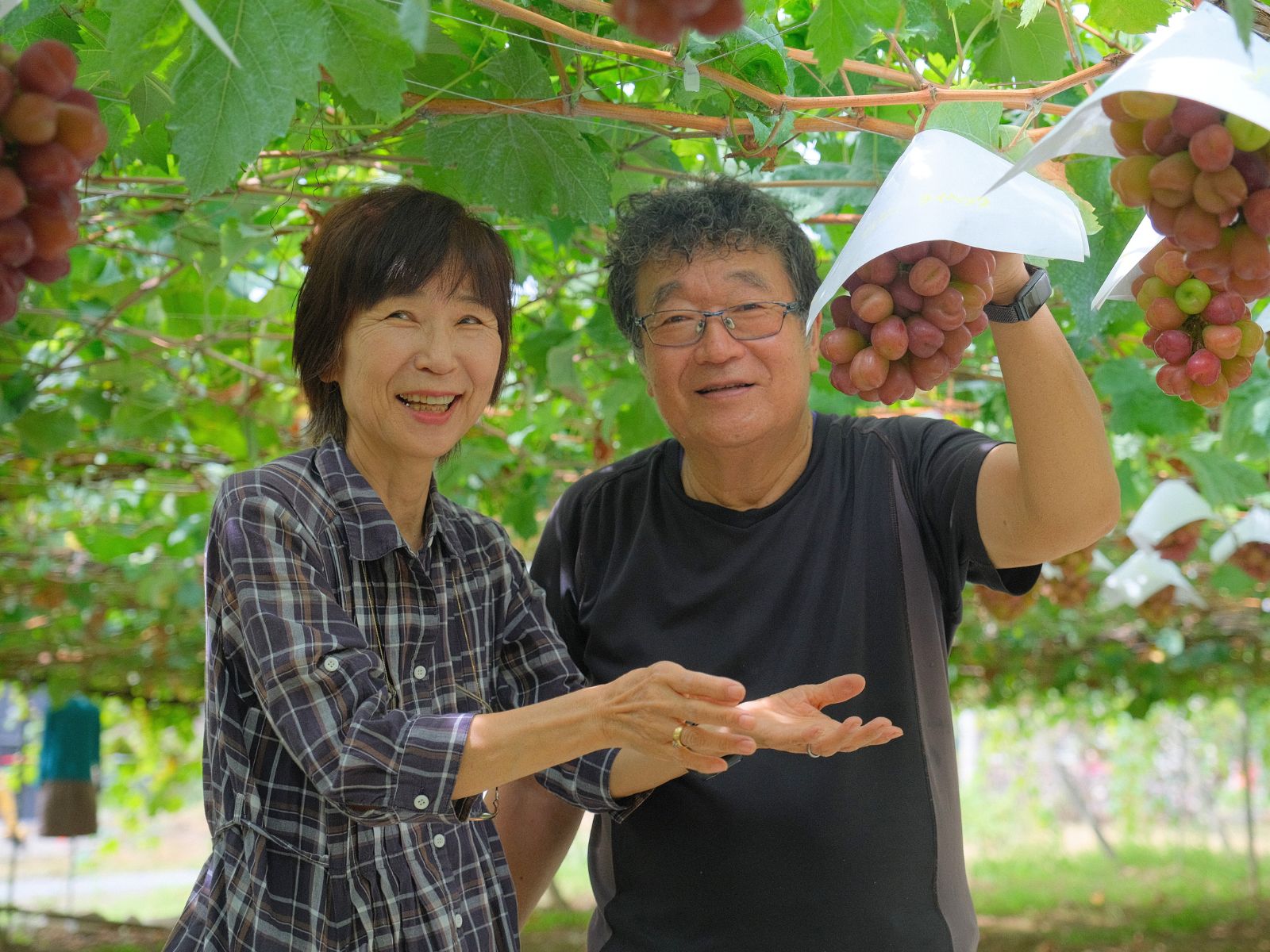
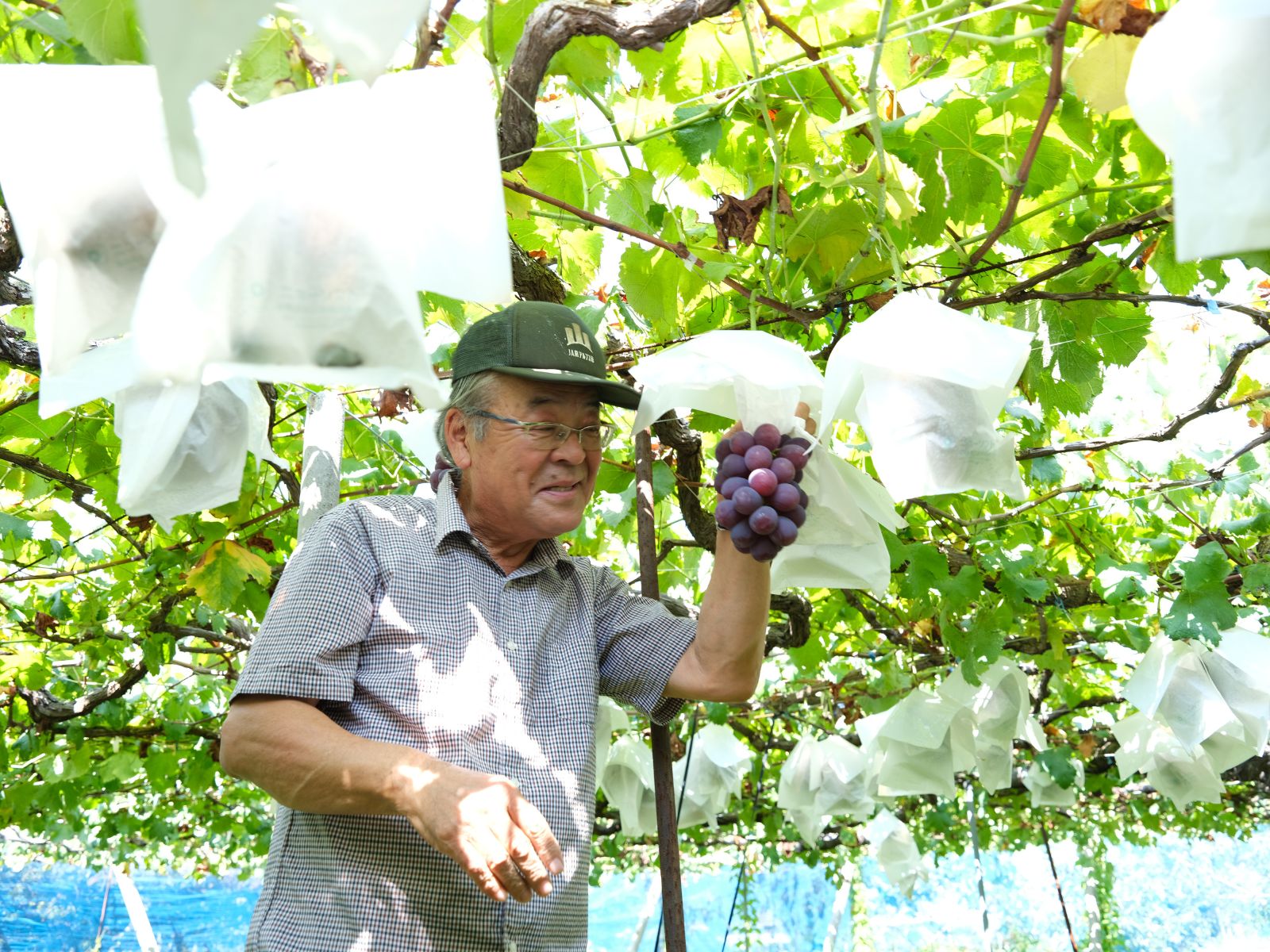
Chibi City, Yamanashi Prefecture, is a peach-growing region that boasts the largest production in Japan. 3 Peach blossoms bloom from late 3 to early 4, their vivid pink color creating a landscape so magnificent that the area is known as "Peach Paradise." In this peach-growing region, Marutou Farm receives a flood of peach orders from inside and outside the prefecture when the season arrives. This time, we visited Masataka and Yoshie Amemiya, the couple behind these popular peaches, to learn about their passion for peach cultivation.

Efforts to Grow Peaches That Are Delicious No Matter Which Fruit You Pick
The area around Ichinomiya Town, where Marutou Farm is located, is a hilly region. Its unique fan-shaped topography allows soil to flow down from the mountains, creating fertile land. In the past, mulberry cultivation and rice farming were the main crops, but the excellent soil and long hours of sunlight gradually led to the spread of fruit trees. The Amemiya family has been growing peaches on this land since the grandfather's generation, and Masataka joined the family business around 2007. He had been working as a designer at an advertising agency in Tokyo, but returned to Yamanashi to support the family business, also considering his parents' age. Although he was exhausted by the unfamiliar farm work, he never spared any effort in learning how to grow delicious peaches, joining the local young farmers' association, "Higashinaka Club," among other things. "Whenever I heard of good techniques for materials or pruning, I went to inspect them even if they were outside the prefecture. I even made a day trip all the way to Fukushima," he recalls with a laugh.
Through years of steady effort and working closely with the peach trees, Masataka and Yoshie Amemiya both agree that the farm's distinctive features are the shape of the trees and the wide spacing between them. As Yoshie recommended, looking down at the farm on Google Maps clearly shows the evenly spaced peach trees with branches that spread out like satellite dishes. While the standard open-center pruning method spreads out 2 main branches, they have increased this to 4 branches to allow the trees to receive more sunlight. They also space the trees so widely that another tree could be planted between each one. "Have you ever felt that some peaches you bought at the supermarket were better than others? Light is extremely important for peaches. We wanted to make delicious peaches with consistently even nutrition, even if they weren't a perfect 100 out of 100, so we repeated countless trials until we arrived at the current shape."
Always Living with Risk: A Commitment to "Fully Ripened Peaches"

Marutou Farm grows seven delicious varieties, led by the juicy peach standard, Hakuho, as well as Higawa Hakuho, Misaka Hakuho, Asama Hakuto, Natsukko, Benikunika, and Kawanakajima Hakuto. Their commitment to growing delicious peaches goes beyond what has already been mentioned. Taking advantage of the naturally fertile land, they use no chemical fertilizers or herbicides, focusing on an environmentally friendly, 100% organic cultivation method. Although grass-covered cultivation is now standard, this farm has been using it for nearly 50 years. By using deeply rooted rye as green manure, they have overcome the weaknesses of the clay-like soil in this region, which is known for retaining nutrients well but making it difficult to supply oxygen.
The greatest appeal lies in harvesting the peaches when they are fully ripe. Peaches sold at supermarkets are often harvested with the time they will spend on the shelf in mind, but Masataka has made it a rule to "never pick unripe fruit." "Even if they look colored a few days after they've been picked, their sugar content won't increase any further once they're off the tree. If you wait until the very last moment on the tree, their sugar content increases and the fruit grows larger. To deliver something delicious, this is something I simply cannot compromise on." Masataka approaches the harvest season with such strong conviction. When the season arrives, whether it rains or a typhoon comes, he goes into the field alone every day to pick only the ripe fruit. He works so hard that those around him say he is like an athlete. Of course, fully ripe peaches spoil quickly, so there are risks. Just one day's delay can ruin their value as a product, or they may fall. To deliver the peaches in the best possible condition, he carefully judges the timing of the harvest and carefully selects business partners, including Katerial, so that they can be shipped immediately after harvest.
Communication Spreading from a Single Peach

Having worked in manufacturing for many years, Masataka began to find the value of creation in agriculture that he had not been able to feel in his previous job as a designer. "When I think about the essence of agriculture, TV brings to mind a country grandmother handing over vegetables she made herself, saying, 'Take this with you.' I feel that this action, born from the desire to have people eat and appreciate the delicious food she worked hard to make, is the very essence of communication unique to agriculture," he says. The farm and the people who eat them, and the people who gave them. He finds the conversations that arise from a single peach to be fascinating. "Nowadays, it's easy to share information through smartphones and the internet, but memories can fade just as quickly. But when you have a real experience, you don't forget something that was delicious, do you? Something that is just okay is easily forgotten, but something truly delicious stays in your memory for life, and you talk about it with the person you ate it with for years to come. It would be wonderful to be able to make peaches that stay in people's memories and minds like that," he says, his passion overflowing as he speaks.
Just a few more months until peach season. Marutou Farm has not yet sent out this year's brochure, but orders are already coming in from fans who have been eagerly awaiting it. Masataka's peaches, filled with sweet juice, will once again travel to many people this year as a new tool for communication.